
The Saint Bernard comes in two coat varieties, smooth coat and rough coat, and comparing smooth vs rough coat Saint Bernards is one of the first questions new owners ask. They are the same breed, held to the same standard, and they can be born in the same litter. In German the two coats have their own names: Stockhaarig, the short or smooth coat, short and dense and lying close to the body, and Langhaarig, the long or rough coat, longer and feathered with the classic fluffy look. Here is how the two coats differ, what each one asks of an owner, and how they look on the dogs of FzyBr Saints.
What the Breed Standard Says
The AKC Saint Bernard Standard, published by the Saint Bernard Club of America (SBCA), describes both coats. The SBCA adds that the two coat types are of equal value. The smooth coat is short and very dense, lying close to the body without being rough to the touch. The thighs show slight feathering, and the tail is covered in longer, dense hair.
The rough coat is of medium length, plain to slightly wavy, and never curled or shaggy. It is more strongly feathered on the forelegs and thighs, and the tail is bushy. Apart from the coat, the two varieties are identical: the same size, structure, head, and markings.
How the Two Coats Look and Feel
A smooth coat Saint shows a clean outline, so structure and muscle are easy to see. A rough coat Saint looks fuller, with feathering on the legs, a ruff about the neck, and a plumed tail. Both carry the familiar red and white or brindle and white markings.
Smooth and Rough Coat Shedding and Brushing
In our experience, the smooth coat is cherished because it shows off a Saint’s structure and muscling with nothing hidden by a groom. You can hide things in a rough coat, but not in a smooth. Easier grooming is just an added bonus, and smooths actually shed more than roughs. Roughs, for their part, tend to win more in the show ring, including all breed wins. Both coats shed and both need regular grooming. Both shed most heavily during seasonal coat changes. A smooth coat usually needs a good brushing once or twice a week. A rough coat needs more frequent brushing, with attention behind the ears, on the legs, and under the tail, where mats form first. Neither coat should be shaved, since the coat protects the dog from both cold and sun.
Equal in the Show Ring
The SBCA’s An Illustrated Commentary on the Saint Bernard Standard (SBCA, 1999) points out that the standard was written to describe the smooth coat dog, and that a rough coat Saint must match the smooth in every way except coat length. Judges are asked to consider both coats equally for awards. The commentary also warns that smooth coat dogs often look smaller and lighter beside a well groomed rough coat, and that this impression is often misleading.
Can a Litter Have Both Coats?
Yes. The SBCA breed history explains that longhaired dogs were crossed in at the hospice beginning in 1830, which is why litters with both coats still occur. Coat type is inherited, and both varieties can appear in the same litter depending on the coats carried in the pedigree. At FzyBr Saints we have lived with both, and we value each dog for temperament, structure, and type rather than coat.
Smooth Coat Saint Bernards at FzyBr Saints

Dino
Dino was a smooth coat male. His short, close coat showed every line of his structure in the ring, where he won Best in Specialty Show at the Northern New Jersey Saint Bernard Club specialty.

Bolt
Bolt was a smooth coat male. He earned Winners Dog and an Award of Merit at the National Specialty preshow hosted by the Northern New Jersey Saint Bernard Club.

Lola Mae
Lola Mae was a smooth coat female and a champion. Her coat was short and dense, with the clean outline the smooth variety is known for.

Remi
Remi is a young smooth coat female and the next planned breeding at FzyBr Saints, once she reaches 18 months of age.
Rough Coat Saint Bernards at FzyBr Saints
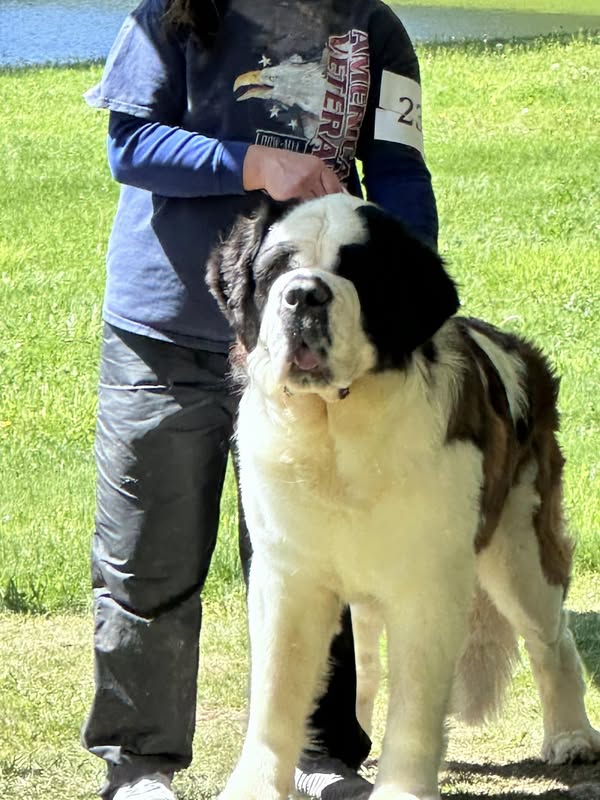
Caesar
Caesar is our rough coat male. His longer coat, feathered legs, and full tail make him a good example of the rough variety.

Yolo
Melon City Yolo is a rough coat female and the foundation dam of FzyBr Saints. Her coat is the medium length, feathered coat of the rough variety.
More Saint Bernard Guides
- Saint Bernard care and grooming
- Saint Bernard size and growth
- Saint Bernard history
- Saint Bernard myths and facts
- The complete Saint Bernard Guide
- Saint Bernard puppies in Massachusetts from FzyBr Saints
Smooth and Rough Coat Questions
Is a smooth coat or a rough coat Saint Bernard a different breed?
No. Both are the same breed, described by the same breed standard, and they compete together in the show ring.
Can one litter have both smooth and rough coat puppies?
Yes. Both coat types can appear in the same litter, depending on the coats carried in the pedigree.
Which coat sheds less?
The rough coat. In our experience smooths shed more than roughs, though both coats are dense and both shed, especially during seasonal coat changes. The rough coat takes more brushing to keep free of mats.
Which coat is better for a family?
Neither. Coat type does not change the Saint Bernard temperament. Choose based on how much grooming you want to do and on the individual dog.
Read more in our Saint Bernard Guide, meet our males and females, or learn about future puppies.
Sources: the SBCA’s AKC Saint Bernard Standard, its breed history, and its member publication An Illustrated Commentary on the Saint Bernard Standard (1999).