
A Saint Bernard puppy grows faster than almost any dog you will ever raise, and raising a Saint Bernard puppy well means the habits you build in the first two years shape the dog he becomes. This guide draws on three Saint Bernard Club of America booklets: The Young Saint Bernard: His Care, Feeding, and Training, Your Saint Bernard Basic Care Booklet, and Congratulations on Your New Companion the Saint Bernard.
How Fast a Saint Puppy Grows
According to The Young Saint Bernard: His Care, Feeding, and Training, a Saint puppy may weigh 16 to 20 pounds at eight weeks and could reach about 40 pounds at three months. The SBCA’s Congratulations on Your New Companion the Saint Bernard notes that many are close to 100 pounds by six months. Expect an awkward stage, too. Through the first year and a half a youngster can stand higher at the shoulder than at the rump, or the reverse, and his head may look out of proportion for a while. Most Saints are not in balance until well past a year and are mature at about three years.
Our Remi is a good example. The photo here shows her at nine weeks, and she is still growing into the smooth coat female she will become.

Remi at nine weeks.
Feeding a Growing Saint
The SBCA’s newer booklets, the Your Saint Bernard Basic Care Booklet and Congratulations on Your New Companion the Saint Bernard, both recommend feeding puppies an adult food rather than a puppy food, with good quality dry kibble as the base. The Basic Care booklet suggests a food in the range of 22 to 26 percent protein and 12 to 16 percent fat. The older The Young Saint Bernard: His Care, Feeding, and Training described puppy kibble, so ask your breeder and veterinarian which food they recommend for your pup.
Every booklet makes the same point about growth: do not push it. Too much food and too fast a gain work against a giant breed puppy, and a lean Saint is better off than an overweight one. The Young Saint Bernard: His Care, Feeding, and Training warns plainly against stuffing your puppy.
- At eight weeks, plan on three meals a day. Around three or four months most puppies are ready for two meals, with the same daily total.
- Give each dog his own bowl, set a few feet apart, and pick up uneaten food after 15 to 20 minutes. The Basic Care booklet recommends stainless steel.
- Keep fresh water available, skip table scraps, and never give bones that can splinter.
- Change foods gradually over several weeks.
Meals and Exercise Do Not Mix
The Basic Care booklet discusses bloat, a serious stomach emergency in large dogs. Its advice for lowering the risk: feed two or three meals a day rather than one, avoid raised food bowls, and allow no exercise for at least an hour before and especially after meals. The Young Saint Bernard: His Care, Feeding, and Training also says to avoid hard exercise around feeding time and in the heat of the day.
Exercise Without Overdoing It
Exercise builds the muscle a big dog needs, but a young Saint’s bones are still soft. The Basic Care booklet explains they do not fully harden until 18 months to two years of age, so all exercise for a puppy should be controlled. Congratulations on Your New Companion the Saint Bernard puts it simply: do not force exercise until your Saint reaches adult size.
- Gentle play and walks on natural ground are ideal. You would not take a three month old puppy on a mile hike.
- Increase the length of walks gradually as your puppy grows.
- No jumping in and out of trucks, no high or long jumps, and no formal agility while the bones are growing.
- Hold off on carting, weight pulling, and road running until the bones are fully hardened, which can take up to two years.
- Puppies playing with other puppies rest when they need to. With adult dogs they tend to overdo it, so supervise.
Footing matters as well. Cover slick indoor floors with nonslip rugs, and plenty of time outdoors helps a puppy build strong muscle. When you pick up a Saint puppy, lift with your hands under the chest and rump, never by the front legs.
Training Starts the Day He Comes Home
A Saint who weighs 150 pounds as an adult should never learn habits you will not want then. The SBCA booklets agree on the basics:
- Do not let the puppy jump up on people, grab hands in play, or steal food from the table.
- Start leash walking right away, and look for a puppy kindergarten class by about four months of age.
- Crate training helps with house training and gives the puppy a safe den. The crate should be about one and a half times the dog’s length and tall enough to stand up in, and it should never be used as punishment.
- A puppy can usually hold it for his age in months plus one hour, so a three month old can manage about four hours.
- Praise him every time he goes in the right spot, and never punish an accident.
The Basic Care booklet describes the weeks from about 7 to 16 weeks as the key window for socialization. Introduce your puppy to new people, places, and sounds at his own pace, keep every experience positive, and use gentle, reward based training. The Young Saint Bernard: His Care, Feeding, and Training adds that Saints are stubborn yet sensitive and eager to please, and that a Saint should never be kept tied or chained.
The Teenage Months
Expect at least one stretch when your well behaved puppy seems to forget everything. The Basic Care booklet says this can happen at six or seven months, again around a year, and in slow maturing dogs at 18 months or two years. Stay patient and consistent, keep him busy with walks, games, and training, and consider a refresher class.
The FzyBr Saints
Remi
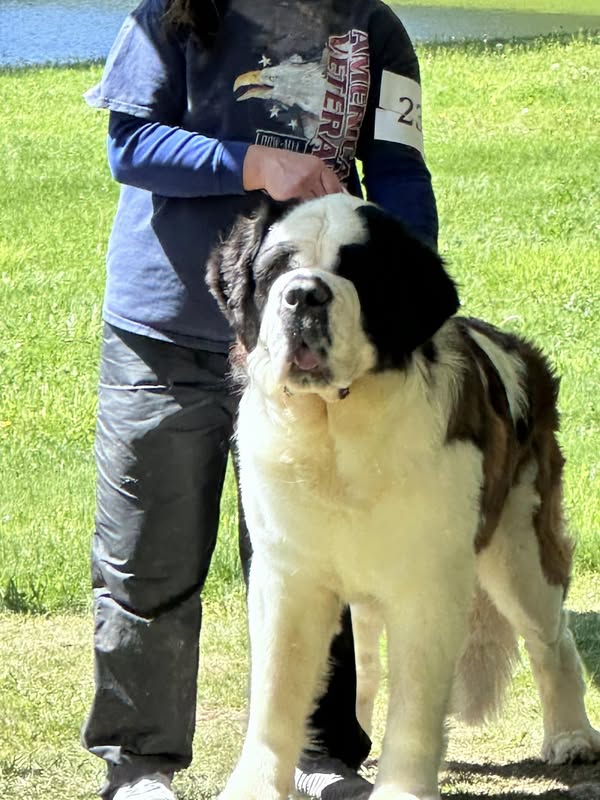
Remi is a young smooth coat female and the next planned breeding at FzyBr Saints, once she reaches 18 months of age.


Bolt
Bolt was a smooth coat male who earned Winners Dog at the Northern New Jersey Saint Bernard Club.
Frequently Asked Questions
Should a Saint Bernard puppy eat puppy food or adult food?
The SBCA’s Basic Care booklet and its Congratulations booklet both recommend an adult food for Saint puppies. Ask your breeder and veterinarian what they recommend.
How much exercise does a Saint Bernard puppy need?
Regular, controlled exercise such as walks and gentle play. Avoid forced or strenuous exercise, jumping, carting, and road running until the bones harden, which can take up to two years.
How big is a Saint Bernard puppy at eight weeks?
The SBCA’s Young Saint Bernard booklet says about 16 to 20 pounds at eight weeks, and up to about 40 pounds at three months.
When should training start?
The day your puppy comes home. The SBCA recommends a puppy kindergarten class by about four months of age.
How long can a Saint puppy stay in a crate?
As a rule of thumb from the SBCA, no longer than his age in months plus one hour.
More Saint Bernard Guides
- Saint Bernard size and growth
- Saint Bernard care and grooming
- Saint Bernard temperament with kids and families
- Buying a Saint Bernard puppy in New England
- The complete Saint Bernard Guide
- Saint Bernard puppies in Massachusetts from FzyBr Saints
Sources
Breed facts on this page come from the Saint Bernard Club of America (SBCA), the AKC parent club for the breed, and the official AKC breed standard, written here in our own words.
- SBCA: The Young Saint Bernard: His Care, Feeding, and Training (PDF)
- SBCA: Your Saint Bernard Basic Care Booklet (PDF)
- SBCA: Congratulations on Your New Companion the Saint Bernard (PDF)
Keep reading in our Saint Bernard Guide, read Buying a Saint Bernard Puppy in New England, or learn about future FzyBr Saints puppies. Questions? Call us at 908-577-0923.