
Saints are known as gentle giants, and the breed earned that reputation. Here is what the breed standard, the Saint Bernard Club of America, and our own dogs tell us about Saint Bernard temperament at home with families and children.
What the Saint Bernard Standard Says About Temperament
The AKC standard asks for a most intelligent expression and describes the eyes as intelligent and friendly. Even in dogs with a dark mask, whose expression looks more stern, the standard says the look is never ill natured.
A Temperament Shaped by Rescue Work
The SBCA history explains that the hospice dogs worked in teams to save travelers in the Alps, so the monks made no allowance for aggression between dogs or toward any traveler. The club notes that this same temperament is expected in the breed today. The SBCA describes the Saint as gentle in spirit and nature, a friend to all, and a dog that truly becomes part of the family.
Saint Bernards and Children
The AKC describes Saints as famously watchful, patient, and careful with children. Size still matters: a friendly dog of this weight can knock over a small child by accident, so supervision and early training are part of living with any Saint. Teaching good manners while the puppy is small makes life easier once he is as big as you are.
Is a Saint Right for Your Family?
The SBCA is honest that the Saint is not the dog for everyone. They shed, and because they are big, they shed a lot. Every Saint drools, and there is no such thing as a dry mouth Saint. Families who are ready for the hair, the drool, and the size usually find a loyal, affectionate companion.
The SBCA on the Saintly Temperament
In An Illustrated Commentary on the Saint Bernard Standard (SBCA, 1999), the club calls correct temperament an extremely important part of the breed. Because Saints were bred to help and find lost travelers, they need an even, friendly temperament that stays calm in hard moments. The commentary describes the ideal Saint as outgoing when nothing threatens, noble, steadfast, and kind, with a real wish to please his people. That temperament is why Saints adapt so well to so many lifestyles and activities today.
The club takes this seriously in the show ring, too. Judges are told that temperament comes first, whatever the dog’s other qualities.
Gentle Guardian, Not a Watchdog
The SBCA’s The Young Saint Bernard: His Care, Feeding, and Training describes the Saint as placid and even tempered, a wonderful dog for children, and a guardian rather than a watchdog. Saints can be stubborn, yet they are sensitive and eager to please, and they do not respond well to harsh handling. The booklet adds that a Saint should never be kept tied or chained.
Kids and Dogs Together
The Your Saint Bernard Basic Care Booklet reminds parents that safety comes first with any dog. Supervise children around puppies and dogs, teach them not to crowd, tease, or stare down a dog, and keep them away from the food bowl. Gentle, positive socialization during the puppy months, roughly 7 to 16 weeks, helps a Saint grow into a calm, confident adult. Expect a teenage phase, too, somewhere between six months and two years, when patience and consistency matter most.
The FzyBr Saints

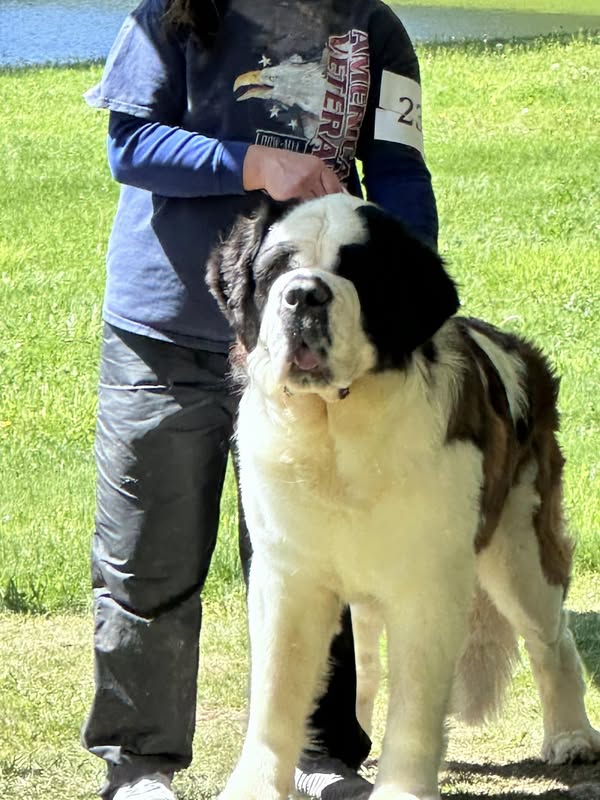


Dino
Dino was a smooth coat male who won Best in Specialty Show at the Northern New Jersey Saint Bernard Club specialty.
Frequently Asked Questions
Are Saint Bernards good with kids?
The AKC describes Saints as watchful, patient, and careful with children. Because of their size, they should always be supervised with young children.
Are Saint Bernards aggressive?
No. The SBCA explains that the hospice monks made no allowance for aggression, and that same temperament is expected in the breed today. The standard describes an expression that is never ill natured.
Do Saint Bernards drool?
Yes. Every Saint drools. There is no such thing as a dry mouth Saint.
Is a Saint Bernard a good family dog?
For families ready for a giant, shedding, drooling dog, yes. The SBCA describes them as gentle companions that become part of the family.
How important is temperament in the breed?
Very. The SBCA’s illustrated commentary calls correct temperament an extremely important aspect of the breed and asks judges to give it top priority.
Is a Saint Bernard a good watchdog?
The SBCA’s Young Saint Bernard booklet describes the Saint as a guardian rather than a watchdog: placid, even tempered, and great with children.
More Saint Bernard Guides
- Raising a Saint Bernard puppy
- Buying a Saint Bernard puppy in New England
- Saint Bernard history
- Saint Bernard myths and facts
- The complete Saint Bernard Guide
- Saint Bernard puppies in Massachusetts from FzyBr Saints
Sources
Breed facts on this page come from the Saint Bernard Club of America (SBCA), the AKC parent club for the breed, and the official AKC breed standard, written here in our own words.
- SBCA: AKC Saint Bernard Standard
- SBCA: About the Breed
- SBCA: Breed History
- AKC: Saint Bernard
- SBCA: An Illustrated Commentary on the Saint Bernard Standard (1999, member publication)
- SBCA: Saint Bernard Standard, illustrated edition (1992, member publication)
- SBCA: The Young Saint Bernard: His Care, Feeding, and Training (PDF)
- SBCA: Your Saint Bernard Basic Care Booklet (PDF)
Keep reading in our Saint Bernard Guide, or learn about future FzyBr Saints puppies. Questions? Call us at 908-577-0923.