
Saint Bernard history is tied in most people’s minds to a hospice high in the Alps. Here we share our own view first, then the official account of the Saint Bernard Club of America, which notes that the breed’s true origins are not fully documented and are best told through known facts and careful reasoning.
The FzyBr View: Farm Dogs First
This is our take, built from what we have learned over years with the breed.
- Saints started in the Swiss valleys as working farm dogs. Farmers used them to pull carts in place of a donkey, a poor man’s donkey or horse, and fed them a working diet heavy on potatoes and vegetables.
- The hospice loved these big draft style dogs, dogs much like our own Yolo, and bred them, in part to sell the puppies. The monks were not chasing precision. They bred whatever large dogs they could find, including Saints from the valleys, possibly Pyrenees dogs, and Leonbergers, which made a real contribution to the dogs of that era.
- The Swiss stud books came later and worked to shape that mix into a defined, pure breed, the Saint Bernard we know today.
The Rescue Story
And then there is the rescue story: the big dog bounding through the snow to find a lost traveler. It is a wonderful tale, maybe a bit of a big fish story that grew with every telling, and we love it as much as anyone. It is a big part of why so many families fall for the breed. We simply like to remember that the Saint’s deepest roots are on the farm.
Keeping the Rough Coat a Saint
Old breeders warned against letting a rough coat drift too far toward the Newfoundland, and they watched for signs such as hair between the toes. The Saint is a different dog. The Newfoundland is more slender, while the Saint is stockier and leans toward the Mastiff side.
From the 1894 Stud Book
The early stud books show that shaping effort up close. The preface to the first German stud book, Band I of the Bernhardiner Stammbuch published by the St. Bernhards Klub in Munich in 1894, is available in English translation in the SBCA Digital Library. It notes that the breed standard was drafted in Switzerland in 1884, the year the first Swiss stud book appeared, with the German book following ten years later.
The writers called the Saint Bernard a modern breed. Their records spanned only about eight generations at most, many registered dogs could be traced back just two or three, and they held that full blood meant at least eight documented generations of pure breeding. They admitted that crossing hospice dogs with Leonberger bitches sometimes produced striking first generation puppies, yet judged such offspring “completely worthless as breeding animals,” and honest breeders worked to remove the half breeds. That is the stud books doing just what we described: turning a mix of big working dogs, Leonbergers included, into a pure breed.
The preface also advised against breeding longhaired dogs to longhaired dogs for generation after generation, because the hospice type never fully shows in the longhairs and fades quickly without a refresh of shorthaired blood, ideally of the hospice type. It is the same worry the old breeders had about the rough coat drifting away from the Saint. Their priorities were clear: first type, then correct conformation, then size, and last color and markings. And for choosing a stud, in their words, “Only the best sire is good enough.”
The Standard Comes to America
The standard the old Swiss breeders worked from was framed in Switzerland in 1884 and ratified at the International Congress in Zurich on June 2, 1887, when nations around the world accepted it, with the exception of Great Britain. The Saint Bernard Club of America adopted it at its founding on February 22, 1888, and the club’s editions grew over the years into the fully illustrated versions of 1992 and 1998.
In 1933, with English type dogs arriving in the United States in growing numbers, the club was reconstituted in New York on February 13 under President Joe Fleischli, joined by Arthur Hesser, Jacob Rupert, and Paul Forbiger. Its 1933 Resolution reaffirmed loyalty to the 1887 International Standard and asked the AKC to have judges follow it. The wording itself was refined with care over time. The early standard called for a tall, upright dog, and the SBCA, working with the AKC, later amended it to stress a tall figure kept in proportion. To us it is the same thread that runs through the old stud books: type comes first.
Below is the official record as the Saint Bernard Club of America and its publications tell it, with dates and sources.
The Official Record: The Great Saint Bernard Hospice
The SBCA traces the hospice to Bernard de Menthon, an Augustinian monk, around the middle of the eleventh century. It stood in a pass through the Alps between Italy and Switzerland at a little more than 8,000 feet, later called the Great Saint Bernard Pass. Snow covered the pass for most of the year, and travelers caught in bad weather often did not survive.
The First Hospice Dogs
Nothing was written about the hospice dogs for centuries. The earliest known images are two paintings from 1695 showing well built shorthaired dogs. Based on those paintings, the most accepted estimate places the breed’s origin between 1660 and 1670. The dogs came from the Swiss valleys near the hospice and likely descended from mastiff style dogs brought over the Alps by Roman armies.
The Rescue Legend, as the SBCA Tells It
According to the SBCA, written records suggest the lifesaving work began around 1700. The dogs first went with the monks on patrols after storms, and later small teams of males were sent out alone. They found travelers buried in snow, dug them out, lay on them for warmth, and sent one dog back to alert the monks. The SBCA notes that the instinct to dig and to rouse a person in snow is still seen in the breed.
Barry
The most famous hospice dog was Barry, who in the SBCA’s telling is credited with saving more than forty travelers. Many Swiss called the breed Barry Dogs in his honor. The English had other names, among them Hospice Dogs and Alpine Mastiffs, until the name Saint Bernard was agreed on in 1880.
Hard Winters and Two Coats
Severe winters from 1816 to 1818 nearly wiped out the hospice dogs, and the monks rebuilt the line with similar dogs from the nearby valleys. From 1830, longhaired dogs were crossed in to protect against the cold. Those crosses included both Newfoundlands and Leonbergers, as the stud books show. Ice built up in the long coats, so the monks returned to shorthaired dogs for mountain work and gave away the longhaired puppies. That is how the breed came to have both the smooth and rough coats seen today.
Standards and the SBCA
Heinrich Schumacher began planned breeding outside the hospice in 1855 and kept the first stud book. The Swiss Kennel Club adopted the first Swiss standard in 1884, and the English wrote their own in 1887. An international congress in Zurich that year chose the Swiss standard for every country except England. The Saint Bernard Club of America, founded on February 22, 1888, holds that the AKC standard, which differs only slightly from the 1884 Swiss standard, best describes the original hospice dog.
More from the SBCA Archives
Club sources differ on the exact founding date of the hospice. The SBCA’s An Illustrated Commentary on the Saint Bernard Standard (SBCA, 1999) gives the year 980, while the club’s online history places it in the middle of the eleventh century and notes that no exact date can be found.
The commentary also discusses the longhaired dogs used in the 1830 crossings and calls the experiment a failure, since ice weighed down the long coats. The monks went back to shorthaired dogs for mountain work almost immediately.
According to the foreword of the SBCA’s 1992 illustrated standard, the text of the breed standard is the one adopted at the international congress in Zurich in June 1887. The Saint Bernard Club of America adopted that same standard at its first meeting on February 22, 1888, with only minor amendments since.
Fact and Fiction
In Fact and Fiction About Our Breed, published by the SBCA, longtime club leader Arthur Hesser separated the breed’s record from its legends.
- The hospice had no dogs until the mid 1600s. Two paintings from 1695 show well built, short haired dogs, and the first written mention of a hospice dog dates to 1707.
- The first record of rescue work is from 1774, and it describes the work as long established by then.
- The story of Barry and his rescues grew in the telling, much like a big fish story, while the breed’s roots are the working farm dogs of the Alpine valleys. Barry spent his last years in Bern, where he died in 1814.
- The dogs were never crossed with Great Danes or Mastiffs at the hospice. Longhaired crosses began in 1830 and brought the rough coat (Langhaarig) into the breed. Long coats collected ice in the snow, so the monks gave the rough puppies away and kept the smooth ones.
- The breed went by many names, including Holy Dogs, Alpine Mastiffs, and Barry Dogs. The name Saint Bernard was settled around 1880.
- Heinrich Schumacher bred from hospice stock outside the hospice beginning in 1855 and kept the first Saint Bernard stud book. The first Swiss standard came in 1884, and an international congress in Zurich in 1887 adopted it.
Read more in Saint Bernard Myths and Facts.
More from the SBCA Breed History
The SBCA’s Breed History page adds several details worth knowing:
- Some attribute the two 1695 paintings to the Italian artist Salvatore Rosa. Professor Albert Heim judged that they show a breed already about 25 years old.
- Before the rescue work began, the dogs most likely served as watchdogs and companions to the monks through their snowbound winters. The monks valued them on patrols because the dogs seemed to sense coming avalanches.
- Males were later sent out in groups of two or three. Travelers who could still walk were led back to the hospice by the dogs.
- The SBCA names Leonbergers donated by Heinrich Essig among the longhaired dogs used in the crosses from 1830. Dedicated Swiss breeders later brought both varieties back to the original hospice type, with only coat length setting them apart.
- The English imported hospice dogs from 1820, crossed some with the English Mastiff, and saw the breed’s popularity take off after 1863. A congress in Brussels in 1886 failed to settle which country’s type was correct, which led to the Zurich congress the following year.
- Today there are three standards: a modified version of the old Swiss standard used in the United States, the English standard, and a much revised Swiss standard adopted by FCI countries in 1993. The SBCA holds that the AKC standard, close to the 1884 Swiss original, is the one that correctly describes the hospice dog.
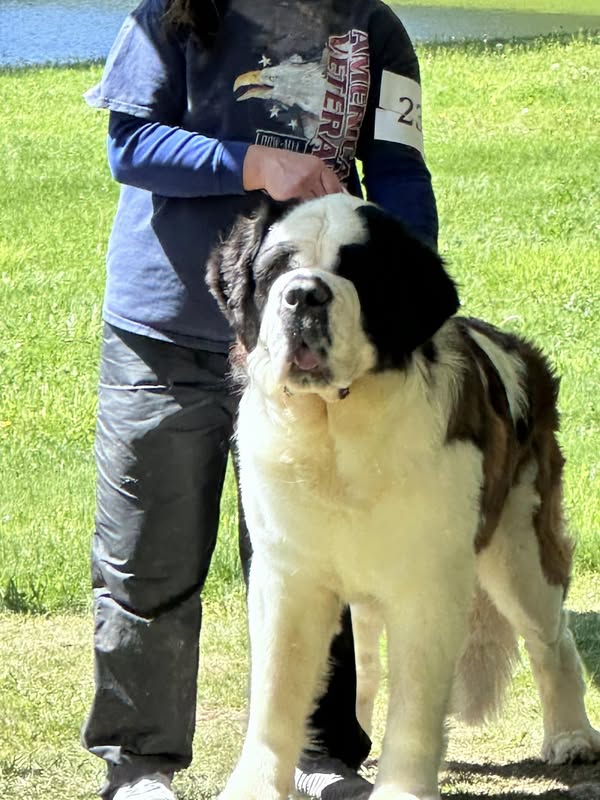
The FzyBr Saints



Frequently Asked Questions
Where do Saint Bernards come from?
The breed developed at the Great Saint Bernard Hospice in the Swiss Alps, from dogs of the nearby Swiss valleys.
When did the breed get the name Saint Bernard?
According to the SBCA, the name was agreed on in 1880.
Who was Barry?
Barry was the most famous hospice dog. The SBCA credits him with saving more than forty travelers.
Why are there smooth and rough coat Saint Bernards?
Longhaired dogs were crossed in at the hospice beginning in 1830. The monks went back to shorthaired dogs for rescue work, and the longhaired puppies went to Swiss breeders, so both coats remain in the breed.
When was the Saint Bernard Club of America founded?
The SBCA was founded on February 22, 1888, and is one of the oldest breed clubs in the United States.
Is the American standard the same as the original Swiss one?
Very nearly. The SBCA adopted the standard from the 1887 Zurich congress at its first meeting in 1888, and it has had only minor amendments since.
When did the rough coat Saint Bernard appear?
It appeared after longhaired crosses at the hospice beginning in 1830, which included both Newfoundlands and Leonbergers, as the stud books show.
Were Saint Bernards really rescue dogs?
They were, in the stories everyone loves, and the SBCA’s official record dates the hospice rescue work to around 1700. The tale may have grown a little with each telling, the way good stories do, and we are happy to keep telling it. In our view, the Saint’s roots go back further, to the hardworking farm and cart dogs of the Swiss valleys that the hospice bred into its famous dogs.
More Saint Bernard Guides
- Saint Bernard myths and facts
- Smooth vs rough coat Saint Bernards
- Saint Bernard temperament with kids and families
- Saint Bernard size and growth
- The complete Saint Bernard Guide
- Saint Bernard puppies in Massachusetts from FzyBr Saints
Sources
Breed facts on this page come from the Saint Bernard Club of America (SBCA), the AKC parent club for the breed, and the official AKC breed standard, written here in our own words.
- SBCA: Breed History
- SBCA: About the SBCA
- SBCA: AKC Saint Bernard Standard
- SBCA: An Illustrated Commentary on the Saint Bernard Standard (1999, member publication)
- SBCA: Saint Bernard Standard, illustrated edition (1992, member publication)
- SBCA: Fact and Fiction About Our Breed, by Arthur Hesser (PDF)
- SBCA: Congratulations on Your New Companion the Saint Bernard (PDF)
- SBCA Digital Library: Our Roots, International (English translation of the preface to the German Stud Book, Band I, 1894)
- SBCA Digital Library: Our Club, Education
Keep reading in our Saint Bernard Guide, or learn about future FzyBr Saints puppies. Questions? Call us at 908-577-0923.